
Builds · Page
Dimraeth Builds: Skill Trees and Respec
Dimraeth builds in the Early Access build: how the skill tree, attributes, spellbooks and gear sets fit together, plus the routes creators are running now.
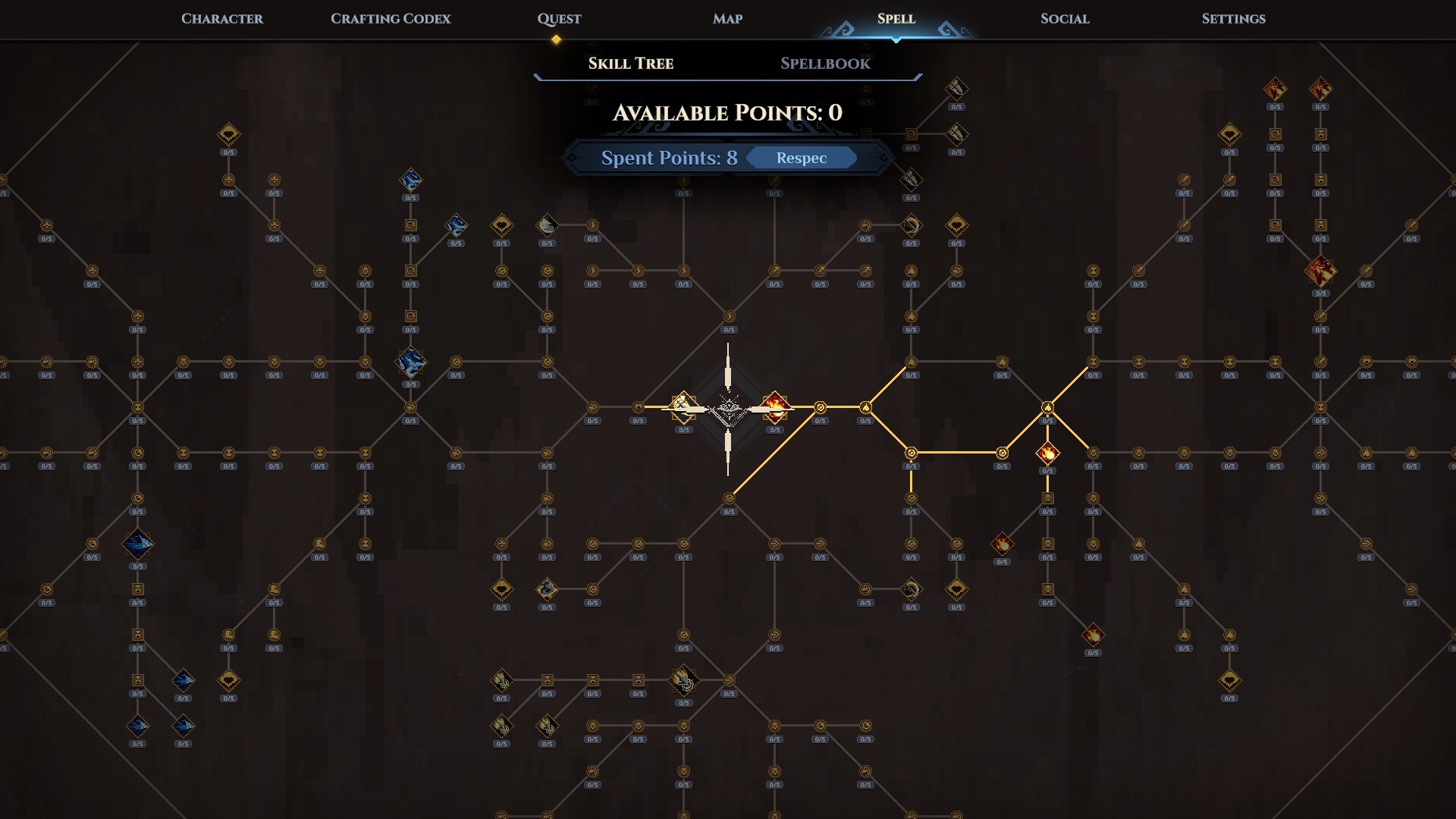
A Dimraeth build is three decisions stacked on each other: the race and class pairing you start with, the skill points you spend as you level, and the attributes you buy with experience. In the build live on 21 September 2026 (EA build 0.107.7725) the level cap is 25 (single source — the studio's Early Access announcement), so the ceiling arrives well before any tree is full, which is why every published route specialises rather than spreading out. Below is how the layers fit together and which specific routes have actually been documented, with every third-party number marked as such.
What a build is made of
| Layer | What it does | Documented by |
|---|---|---|
| Race and class pairing | Sets your weapon family, your racial ability and, per creator guides, which wings of the tree open | Studio confirms the pairing; the weapon detail is creator-reported (single source) |
| Attributes | Bought with experience; the spend also raises your character level | Third-party guide (single source) |
| Skill points | Awarded per level and spent on the tree; refundable | Third-party guide and creators (single source) |
| Spells and spellbooks | Extra actives obtained from recipes you find and craft | Creator and third-party guides (single source) |
| Gear sets and upgrades | Set bonuses, plus some effects that change how a skill behaves | Creator and third-party guides (single source) |
The studio's own framing is that races and classes bring "distinct racial abilities" and "class synergies" into a flexible skill tree, so the layers above it sharpen a direction rather than create one. Everything in the rows below that line is player documentation: Mudtek has published no build guidance, no attribute tables and no statement about which combinations are strongest. Where two sources disagree, this page says so instead of picking one.
Skill points, attributes and respec
Experience is spent rather than banked: you pay it into an attribute, and the same spend advances your character level, which is what awards skill points. One third-party guide recorded a level 11 caster holding 3,136 unspent XP with Memory at 11 and Intelligence at 13, and reported that each level earned through training gave two skill points (single source — third-party guide). That is the mechanism behind the advice that repeats across every route: hold experience until you know which breakpoint you are buying.
Respec exists in two separate forms and they are not equally cheap. Creators report that skill points can be taken back at the melee skill trainer, free early and charged per point afterwards, while attribute points need a consumable potion bought from the Earlwood merchant for 500 gold and restocked daily (single source — creator guides). One creator described buying that potion specifically to reclaim points spent on Adventure during the campaign (single source).
Persona and character creation
Persona is one of the systems the studio lists alongside the skill tree, equipment sets and base building, and it is chosen when the character is created. Creator commentary from the launch guides treats it as the least consequential of the opening choices, with one creator stating plainly that they had not seen it matter (single source — creator guide). A third-party launch review describes the choice as sitting between heroic, scholar, joker and stoic, and says each one begins the character with a different sheet of stat numbers (single source — third-party review).
There is no official explanation of what Persona changes mechanically, so the practical reading is that it is a starting-condition choice rather than a build axis. The attribute sheet it reportedly hands you is the only part that could interact with a build, and even that is reframeable later through respec. If the studio publishes the numbers, that is when it becomes worth planning around.
Documented build directions
| Route | How it works | Documented by |
|---|---|---|
| Minotaur Brawler, Bleed | Applies Bleed stacks and then spends them for burst; one creator reported a boss reaching 16 stacks before dying | Third-party guide (single source) |
| Human Brawler, Furious Strike | A strike that costs health, built for critical hits; one creator reported roughly 3,644 on a critical hit | Creator guide (single source) |
| Elf Shadow, Bleed and clones | Builds around Bleed and a racial capstone that consumes 10 stacks for an extra shadow clone | Creator guide (single source) |
| Shadow, Poison and Decay | Uses Poison and Decay effects to recover the Concentration that funds further casts | Third-party guide (single source) |
These are four reporters' own characters, not a curated list of the strongest options. The Minotaur Brawler route appears in more than one guide as a starting suggestion because it is described as an area-cleaving build that does not depend on gear (single source). The Elf Shadow route is the clearest demonstration of race mattering, since its capstone exists only for that race (single source).
Where gear changes a build rather than supporting it
Set bonuses are the layer most likely to reshape a character. A third-party guide describes keeping a three-piece bonus instead of a slightly stronger single item, because +10% Aether Damage and +10% Concentration Regen did more for that caster than a better roll would have (single source). It also describes set pieces that alter how a skill works — one turns a spell into three roots in a cone — which is a bigger change than a percentage (single source).
That is why the material argues against chasing six pieces the moment one drops. The advice is to keep the bonus you can actually equip until its replacement is complete, and to treat stored gear as encumbrance unless you can already say which breakpoint it serves. A creator worked the same problem from the other direction, moving off an early health set only once three pieces of a physical-damage set were available (single source).
Do not spend a status effect just because you can
Several abilities let you consume the status effects your build is already applying, and the most useful warning in the material is that this is not automatically an upgrade. If a boss is carrying double-digit Bleed stacks that keep ticking while you dodge, spending them for one mediocre burst can be worse than leaving them in place (single source). The test the guide proposes is whether the spender beats what those stacks would have done on their own.
The same logic applies to dropping a skill. One creator's build kept a simple damage ability for most of the campaign and replaced it only when the dedicated package could stand without it (single source). Removing the bridge early is the most common way a half-finished build ends up weaker than the messy one it replaced.
What the studio has not published
No official build guides, no official attribute tables and no official statement about which combinations are strongest, so this page contains no tier list and no ranking. Every number above comes from a creator or a third-party guide and is marked, and anything the studio has not addressed is left as an open question rather than filled in. If you are planning a party rather than a solo character, check multiplayer before you commit to a role, and the community page lists where builds are actually discussed.
FAQ
- Is there a best Dimraeth build?
- No official build guidance exists, so this page publishes no tier list and no ranking. What the material does show is convergence on one forgiving starter: a Minotaur Brawler built around Bleed is described by more than one guide as an area-cleaving character that does not depend on gear (single source — creator and third-party guides). Every route below is a reporter's own character rather than a curated meta list.
- Can I respec a build in Dimraeth?
- Yes, in two separate forms. Creators report skill points can be taken back at the melee skill trainer — free rearrangements early, then a gold cost per point — while attribute points need a consumable potion sold by the Earlwood merchant for 500 gold, restocking daily (single source — creator guides). The guide covers where those systems sit in the early game.
- What does Persona actually change?
- The studio's own materials list Persona among the game's systems alongside the skill tree, equipment sets and base building, and it is chosen when you create the character. Creator commentary from the launch guides treats it as the least consequential opening choice, with one creator saying they had not seen it matter (single source). A third-party review describes the options as heroic, scholar, joker and stoic, each starting you with a different sheet of stat numbers (single source — third-party review). No official explanation of its effects has been published.
- How much does the level 25 cap limit a build?
- It limits how much of the tree you can fill. Levels award skill points, one creator at the cap reported having spent their points down two of the tree's four directions rather than four, and the cap itself is 25 in the build live on 21 September 2026 (EA build 0.107.7725; level cap per the studio's Early Access announcement, single source). The practical effect is that a build is a set of choices rather than a collection of everything.
- Do I have to copy a build to make progress?
- Not according to the material. The guides written so far emphasise choosing the archetype whose idea appeals to you and note that spend can be refunded later (single source), and the level-25 route documented by one creator used deliberately low-rarity gear while still hitting hard (single source). If you want the systems underneath the choices, start with classes, races and spells.
References
- Dimraeth – A 1-8 Player Co-op Fantasy RPG | dimraeth
- Dimraeth Builds Guide: Shadow DoT & Bleed Brawler
- How To Build The Shadow For BIG DAMAGE in Dimraeth!
- OP "Crimson Death Fist" SIMPLE Endgame Build in Dimraeth
Facts on this page are compiled from the references above. Items marked "to confirm" are single-source and not yet verified.